
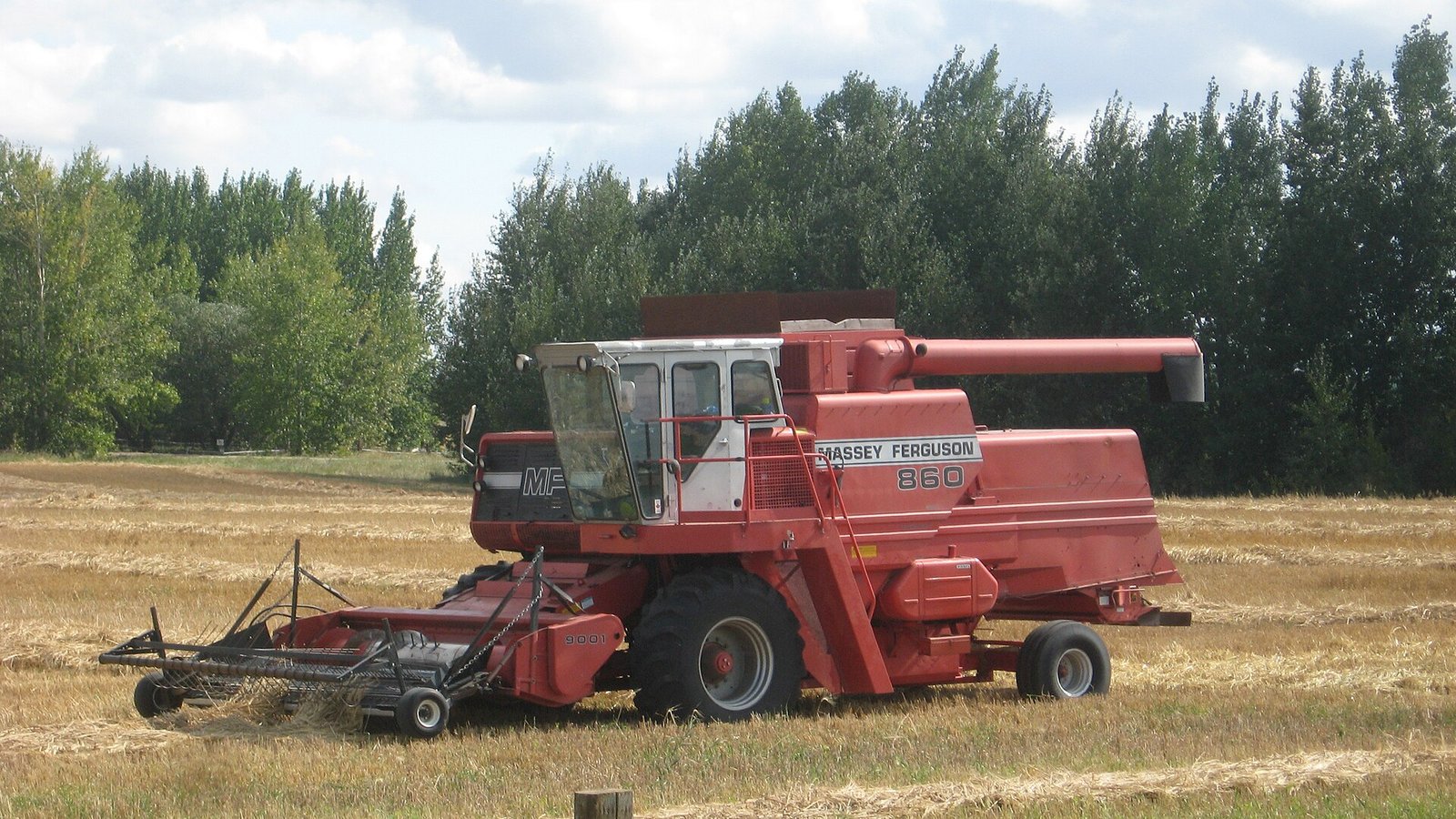
A combine running canola at full tilt processes 600 to 1,000 bushels an hour, according to combine-capacity figures reported by The Western Producer. At the Peace Region’s spot canola price of $769.85 a tonne in mid-August 2026 — about $17.46 a bushel using the Canadian Grain Commission’s standard conversion of 44.092 bushels per tonne — that machine puts somewhere between $10,478 and $17,464 worth of crop into the tank every hour. When the combine breaks down, that number does not go away. It just stops flowing your direction.
This is the real math behind a September breakdown. Not “downtime costs money” as an abstract idea, but an actual dollar figure tied to a real bushel count, sitting parked in a field north of Dawson Creek while someone waits on a part.
Why the Peace Region can’t afford to wait
The Peace Region grows almost 90% of British Columbia’s grain, 95% of its canola, and 90% of its dry field peas, according to the City of Dawson Creek. British Columbia’s average canola yield in 2025 was 42.3 bushels an acre, per the Canola Council of Canada. Nearly all of that acreage sits in this one region. One farm here can run several thousand acres through a single combine in a six-week window. There is no slack in that schedule.
The season is short, too. Climate normals for Dawson Creek put the first fall freeze anywhere between September 3 and October 12. A grower who loses two days to a broken combine in early September is not just losing two days. They are betting those two days against a frost date that could land before the crop is in the bin. Standing canola caught by an early frost can lose both yield and grade — a marketable crop turns into a discounted one overnight.
The part is never on the shelf you need
Dealer networks do serve this region. PrairieCoast Equipment carries John Deere parts and service in both Dawson Creek and Grande Prairie. But no single branch stocks every part for every machine. During the weeks when the whole Peace Region combines at once, the specific bearing or hydraulic fitting that failed on a ten-year-old machine can be sitting on a shelf in Edmonton, Calgary, or a specialty supplier in the Lower Mainland — not at the counter closest to the field. One header-drive bearing, unavailable locally, can park a half-million-dollar combine for a full day while a farm’s own truck and driver make an eight-hour round trip to fetch it.
What waiting on regular freight actually costs
A standard parcel courier or LTL carrier routes a part through a sorting hub before it moves again — Calgary or Edmonton for anything shipping out of Alberta, Vancouver for anything out of the Lower Mainland. That one stop routinely adds a full day to a delivery that should take half that. During harvest, a full day can be the difference between beating a frost and not.
Canyon Runner dispatches every emergency run from its base in the Lower Mainland. This is not a truck stationed locally — it is a direct drive that starts more than a thousand kilometres south. The run north to the Dawson Creek and Fort St. John corridor covers roughly 1,220 km, about 11 to 12 hours, mostly on Highway 97 through Prince George and the Pine Pass. What makes it faster than regular freight is not the distance. It is that the part goes straight from the supplier’s counter into the truck bed, then straight to the field — no sorting hub, no consolidated load, no second driver handing it off partway.
Why the premium is a rounding error
Run the math the other way. At $17.46 a bushel and 600 bushels an hour, one hour of stopped harvest is worth more than most emergency freight invoices for the entire trip. A hotshot run covering 2,440 km round trip, priced in the thousands of dollars, is a rounding error next to a combine sitting idle for two or three days on a slower option — or sitting idle until frost sets the final number for you.
Canyon Runner’s accessorial charges are published, not buried in a quote email after the fact. Detention runs $140 an hour after a separate 30-minute grace period at each of pickup and delivery. A layover that forces an overnight stop is a flat $375. Cargo carries $2.00 a pound in liability coverage. Nothing on an emergency harvest run should come as a surprise on the invoice.
Before the combine breaks down
Save a number in the phone now, before the machine goes quiet in the field. Label it “EMERGENCY HOTSHOT,” not “trucking company.” That difference matters when a header-drive bearing fails at 7 p.m. on a Tuesday in the second week of September, and the part is sitting on a shelf 1,200 km away. Canyon Runner’s dispatch line is 778-302-1632.
Photo: Massey-Ferguson 860 combine, rural Saskatchewan, September 2008. Trekphiler, Wikimedia Commons, CC BY 3.0.