
The corridor: Cochrane to the Highway 3 junction
Highway 22 runs 574 km through Alberta, from Highway 18 near Mayerthorpe in the north to Highway 3 near Lundbreck Falls in the south. Southern Alberta calls it the Cowboy Trail. The stretch that matters for ranch freight starts at Cochrane, 208 km up from the south end, and runs south through Longview (109 km) and Diamond Valley, the former Black Diamond and Turner Valley (128 km), into the Municipal District of Ranchland, ending at the Highway 3 junction near Lundbreck. Pincher Creek sits another 17 km east on Highway 3. That’s roughly 225 km of two-lane highway between Cochrane and Pincher Creek, with almost no incorporated towns along the way.
Ranching country, not scenery
The Municipal District of Ranchland No. 66 covers 2,637 km² between Longview and the Highway 3 junction and had 110 residents at the 2021 census — one person per 29 km², the lowest population density of any municipal district in Alberta. It has no incorporated towns inside its boundaries. Its own governing documents describe the terrain as unsuited to crop farming and state that ranching remains the sole livelihood of its residents. The MD’s administration office sits at the Highway 22 and Highway 533 junction, next to Chain Lakes Provincial Park.
Foothills County, which the highway also crosses near Longview and the Highway 541 junction, carried 162,603 cattle and calves as of 2021 — the fifth-highest cattle population of any municipality in Alberta, up 30.7% over the prior five years. This is a working cattle economy that runs on a calendar, and freight into it has to run on the same calendar.
What actually ships on the Cowboy Trail
Canyon Runner doesn’t haul cattle. A half-ton hotshot with an 800 lb, 5’7″ x 50″ x 60″ bed and a 1,500 lb, 140″ x 78″ trailer deck isn’t built for livestock trailers, and that isn’t the freight this corridor generates for us. What it generates is parts and equipment: a hydraulic cylinder for a squeeze chute, a replacement axle and hub kit for a gooseneck stock trailer, rolls of high-tensile fence wire, headgate parts, corral panel hinges and gate latches. Hi-Hog Farm & Ranch Equipment, which has built livestock handling equipment on the northeast side of Calgary since 1967, sits a short run up Highway 1 from the north end of this corridor — the corral panels and calving equipment on ranches between Cochrane and Pincher Creek often started at a plant like that one.
Fall roundup runs on a sale date, not a delivery window
Weaning and shipping calves in Alberta runs from September through November, with the heaviest volumes typically landing in October and November as producers time the work around fall fieldwork and market conditions. The Southern Alberta Livestock Exchange in Fort Macleod, a short drive south of the Highway 3 junction, runs calf and yearling sales on a fixed Tuesday schedule that builds through late summer into the fall run.
A sale date doesn’t move for a broken part. If a squeeze chute’s hydraulic cylinder fails two days before a Tuesday sale, the crew can’t sort, weigh or vaccinate calves on schedule. The load isn’t late by a day — it misses that week’s sale and waits for the next one. That’s the real cost of a slow parts run in this corridor: not a delayed Tuesday, but a lost week.
Scales, permits and what trips up shippers on this route
The nearest commercial vehicle inspection stations to this corridor are the Cochrane MIS at the north end and the Claresholm MIS near the south end, reached off Highway 22 via the Highway 520 spur toward Claresholm. There’s no scale directly on Highway 22 between them. Alberta’s legal dimensions without a permit are 2.6 m (8’6″) wide and 4.15 m (13’6″) high; a load wider than that needs a permit and red or orange warning flags at least 400 mm on a side, mounted where the load runs widest. Corral panels carried lengthwise on a trailer rarely cross that width, but a long panel with a rear overhang approaching 21 feet starts running into the same permit and flagging territory as any other oversize load — worth checking before the panels get loaded, not after.
Dispatch is still the Lower Mainland
None of this changes where the truck starts. Every Canyon Runner load into this corridor dispatches from the Lower Mainland, the same as a Calgary run — Cochrane sits about 20 km short of Calgary on Highway 1, so the drive in runs roughly 950 km via Kicking Horse Pass and Rogers Pass. From there the corridor adds another 225 km south to Pincher Creek. A part bound for a ranch yard near the Highway 3 junction is close to a 1,175 km one-way run, all of it starting in the Lower Mainland. There’s no local truck sitting in Cochrane or High River waiting on a ranch call.
What a stalled load costs
Canyon Runner’s accessorial rates are the same in ranch country as anywhere else: detention runs $90/hr after a 60-minute combined grace period at pickup and delivery, a forced overnight layover is a flat $375, and cargo carries $2.00/lb of liability coverage. A ranch yard reached by a grid road off Highway 22 often has no address a GPS can find and spotty cell signal to call ahead. If the crew isn’t at the gate when the truck arrives, that detention clock starts the same as it would outside a loading dock in Surrey.
Before booking equipment freight into ranch country
- Get the legal land description or GPS coordinates for the yard, not just a mailing address — most ranch gates off Highway 22 don’t have one.
- State the actual auction sale date or roundup day the part has to beat, not a generic “this week” delivery target.
- Confirm whether a panel or gate load has a rear overhang near or past 21 feet, so the truck arrives with flags already mounted instead of losing time at the yard.
- Ask who will be at the gate and when — cell coverage is thin through the MD of Ranchland, and a missed window here runs the same detention clock as a missed dock appointment in the city.
- Confirm the carrier runs the same truck for the whole trip, Lower Mainland to gate, rather than handing the load off partway through Alberta.
Related Reading
- Zero-Stop, Direct-Drive: Why Procurement Managers in Calgary and Edmonton Are Switching to Hotshot for Small Freight
- Wellsite Down in the Peace Region: Inside a Direct-Drive Emergency Parts Run from the Lower Mainland
- Winter on the Crowsnest: Running Highway 3 Freight from the Lower Mainland to the Elk Valley
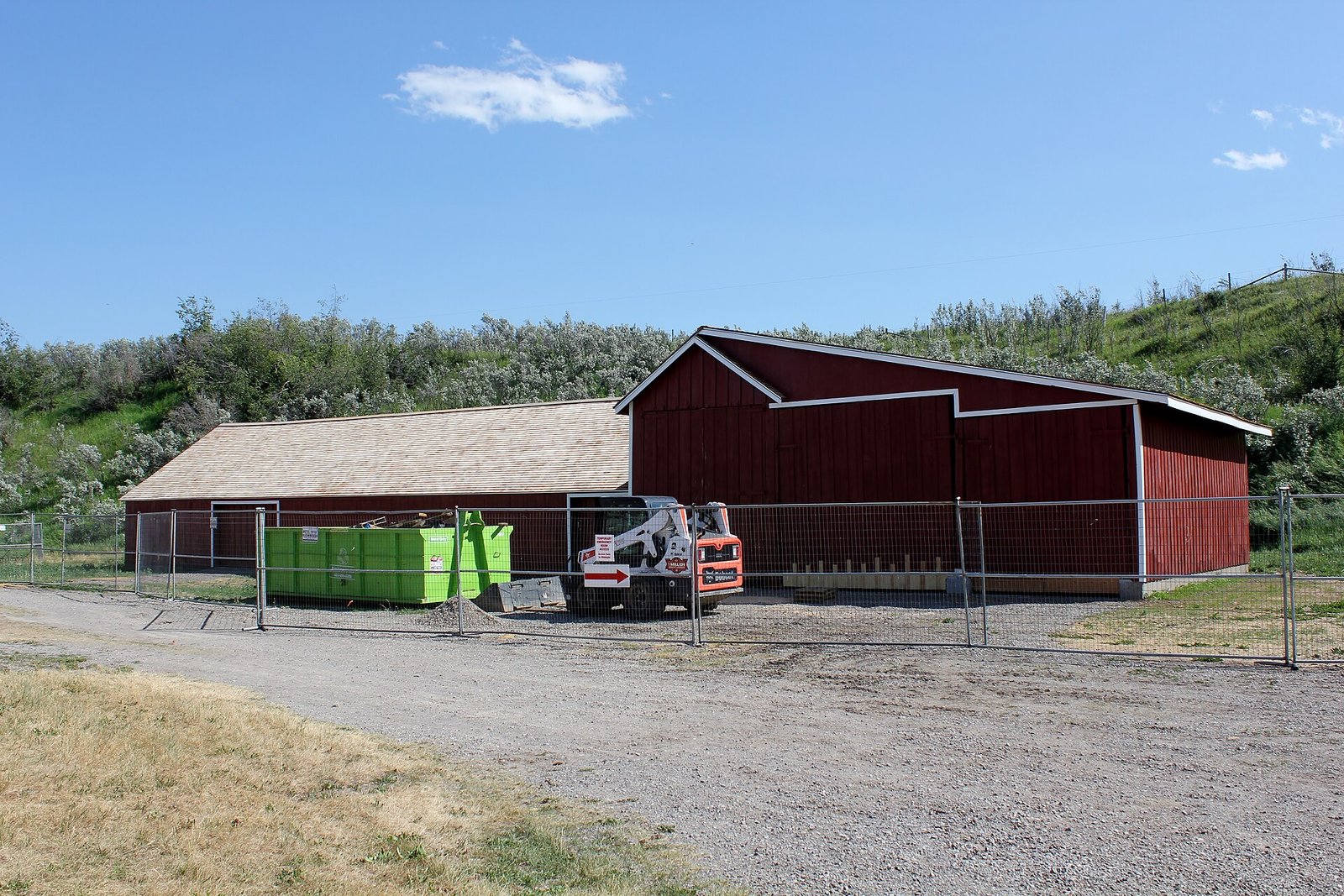
Photo: Implement shed, Bar U Ranch National Historic Site, Highway 22. Jeffery J. Nichols, CC BY-SA 4.0, via Wikimedia Commons.