
A hydraulic pump ships from a supplier’s dock in the Lower Mainland on a Monday morning. Routed through a national courier network, it clears the Vancouver sorting hub that afternoon, rides a linehaul trailer overnight to the Calgary hub, sits in that hub’s inbound queue until it’s scanned and re-sorted, then goes out for local delivery — Wednesday at the earliest, sometimes Thursday if the linehaul trailer is already full. Two sort stops, one overnight hold, and the part still hasn’t reached the job site. That’s the gap Zero-Stop, Direct-Drive is built to close: one truck, one driver, no hub in between.
What Zero-Stop, Direct-Drive Actually Means
A parcel or LTL shipment moving through a standard courier or freight network touches a sorting hub at least twice — once near the origin, once near the destination — before a local delivery driver ever picks it up. Each hub stop means the freight sits until there’s a full truckload or a scheduled linehaul run, not until it’s convenient for the job site waiting on it. Canyon Runner Hotshot skips both hub stops. The truck that leaves the supplier’s dock in the Lower Mainland is the same truck that pulls up to the job site in Calgary or Edmonton — no cross-dock, no re-scan, no waiting on someone else’s linehaul schedule.
The Freight That Fits
This isn’t the right tool for a pallet of lumber or a skid of drums. The sweet spot is urgent, high-value freight under 1,000 lbs that fits in a standard truck bed: a hydraulic pump for a stalled excavator, an electrical control panel holding up a plant restart, a box of specialized drill bits for a rig that’s already burning daylight, a replacement PLC module for a production line. A $4,000 part sitting in a courier hub queue for two extra days can cost a job site far more than that in idle labor and lost schedule — the freight cost stops being the number that matters.
The Regulatory Edge
A loaded semi is bound by the same federal Hours of Service rules whether it’s hauling steel coil or a single 40 lb pump: once a vehicle’s GVWR or GCWR passes 4,500 kg, the driver runs on a logged clock, and when that clock runs out, the truck stops — on the shoulder, at a truck stop, wherever the hours ran out, not necessarily anywhere near the job site. A Ram 1500 hotshot stays under that threshold. There’s no logged clock forcing a shutdown partway through a run to Calgary or Edmonton, which means the truck that left the Lower Mainland in the morning can still be rolling that night if the job needs it. In British Columbia specifically, that same sub-5,500 kg licensed GVW also exempts the truck from mandatory weigh scale reporting and from seasonal load restrictions that can otherwise cut a loaded semi’s axle weight by half during spring break-up — a real advantage on the BC portion of any Interior-bound run. (Alberta hasn’t published an equivalent GVW floor, so that specific exemption is a BC-only advantage — worth knowing if a run continues past the border.)
From the Lower Mainland to the Job Site
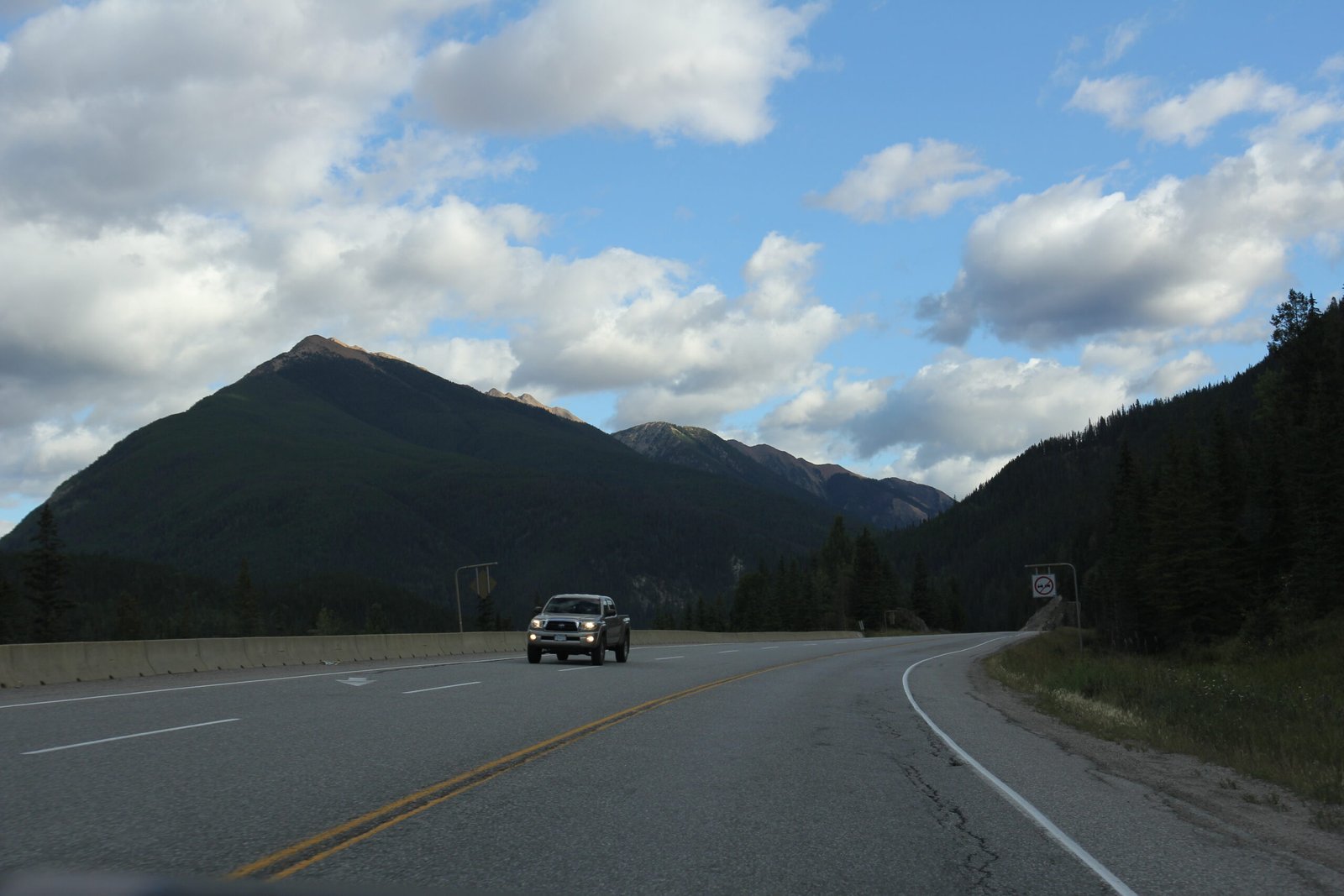
Every Canyon Runner run starts at the yard in the Lower Mainland — this isn’t a Calgary-based or Edmonton-based operation running local delivery once freight already happens to be there. To Calgary, that’s over 950 km on Highway 1 through Kicking Horse Pass and Rogers Pass, a run that puts a truck on-site the same day for an early pickup. To Edmonton, the route runs the Coquihalla north before picking up the Yellowhead Highway east through Jasper, over 1,150 km — still a single truck, a single driver, no relay. Compare that to a courier shipment covering the same distance: it isn’t traveling in a straight line at all. It’s riding a linehaul trailer to a hub, waiting for capacity, riding a second trailer to a second hub, and waiting again for a local delivery route to have room for one more stop.
What This Costs, and What It’s Worth
A dedicated truck costs more per shipment than a courier waybill — that’s not in dispute, and there’s no reason to pretend otherwise. What a courier waybill doesn’t put a price on is the two extra days a plant sits without its control panel, or the shift a drilling crew loses waiting on a part that’s still sitting in a hub queue two provinces away. For freight that’s actually urgent, the math runs the other direction: the premium on a direct-drive run is a rounding error next to the cost of the delay it prevents.
If a part is genuinely holding up a job site in Calgary, Edmonton, or anywhere between, call Canyon Runner Hotshot before it goes into a courier network it won’t get out of quickly. One truck picks it up, one truck delivers it, and nothing about that changes between the Lower Mainland and the job site.
Thumbnail photo: “Kicking Horse Pass BC AB on the Trans Canadian Highway” by Royalbroil, via Wikimedia Commons, licensed under CC BY-SA 3.0.
