
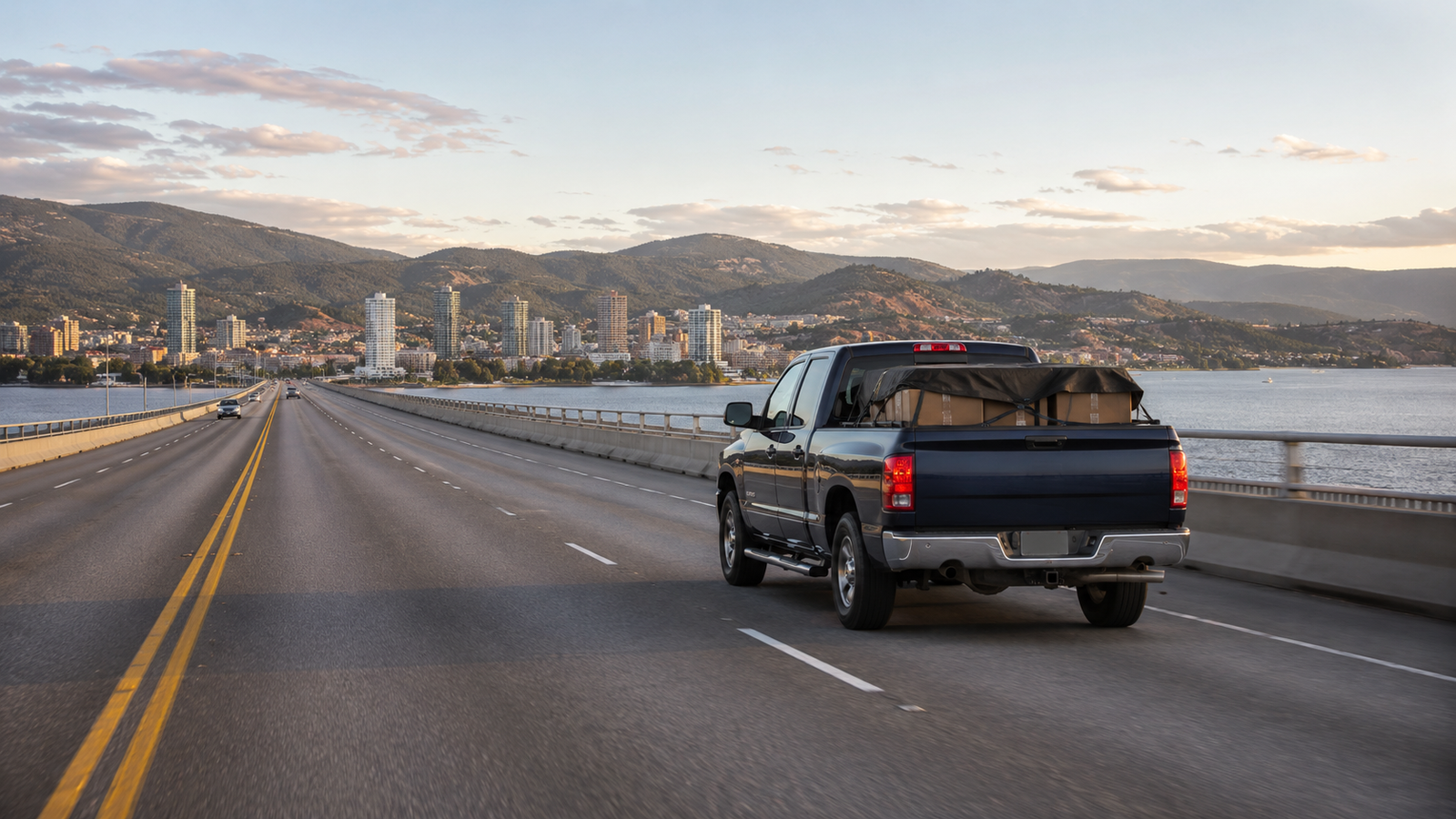
A flat-rate quote from Canyon Runner already includes deadhead miles, fuel, and tarping up to the truck’s capacity: $3.50 per kilometre round trip for the truck, 25% more if the load needs the trailer. That number doesn’t grow once the invoice shows up. In the BC Interior, a quote that comes in noticeably lower usually means the carrier is missing something — insurance, equipment, or the experience the corridor actually demands.
What Actually Sets the Price
A dedicated hotshot run isn’t shared with other freight, so the quoted price covers the full round trip, not just the loaded half. A truck running from the Lower Mainland to Kelowna and back covers roughly 780 km combined, and both halves get billed the same rate, because the truck isn’t available for another job until it’s back at the yard. Deadhead miles aren’t a discount just because the bed is empty on the way home.
After-hours dispatch carries its own cost too. A driver taking a call at 11 p.m. for a 2 a.m. pickup isn’t running a scheduled route — they’re rearranging their night to get a part moving. Detention runs $140 an hour after a 30-minute grace period at each stop — pickup and delivery are tracked separately, with no shared pool. Layover is a flat $375 when a job can’t finish in a single day, whether that’s a receiving yard closing before the truck arrives or a highway closure eating the drive window. A shipper who books a 6 p.m. delivery to a yard that closes at 5 p.m. isn’t paying for someone else’s mistake — they’re paying $375 because the truck and driver are now stuck overnight instead of running another job the next morning.
What a Cheap Quote Is Usually Missing
A quote that undercuts the market by a wide margin is rarely a better deal — it’s a different set of terms that show up later. A shipper who books based on a number $200 lower than everyone else often finds a fuel surcharge added to the final invoice that was never mentioned at booking, or an hourly detention rate that only gets disclosed after the truck is already sitting at a closed dock. The cheapest number on the phone and the number on the final invoice aren’t always the same number.
The Equipment Standard a Legitimate Hotshot Actually Runs
National Safety Code Standard 10 sets the cargo securement rules every commercial carrier in BC has to meet, and the math is specific. The aggregate working load limit of the tie-downs on a load has to equal at least 50% of the cargo’s weight. The securement system has to hold the load through 0.8g of forward deceleration, 0.5g rearward, and 0.5g sideways — the forces of a hard brake or a sudden swerve, not just steady highway driving. Cargo up to 3.04 metres long needs a minimum of two tie-downs; every additional 3.04 metres or fraction of it adds one more. Every strap and chain used has its own stamped working load limit, and that figure has to actually be checked and added up against the load’s weight, not eyeballed.
Cargo insurance isn’t legally mandated in Canada, but a serious carrier carries it anyway and can quote a real number — Canyon Runner insures freight at $2.00 per pound, and any carrier’s coverage should be backed by a certificate they can produce before the load is on the truck, not after something goes wrong.
Five Things to Ask Before Booking an Emergency Load
Ask for a certificate showing the carrier’s aggregate cargo insurance limit before booking, not after. Ask whether the quoted price includes deadhead miles and fuel, or whether those get billed separately once the load is delivered. Get the detention and layover policy in writing before the truck leaves the yard. Ask how many tie-downs and what strap rating the carrier runs for a load of this size and weight. Ask whether the driver has actually run this specific corridor in winter conditions, or whether this run would be a first attempt.