
A dedicated truck out of the Lower Mainland can put an urgent part on a job site in Kelowna or Kamloops the same day it’s picked up. Route that same part through a national courier network instead, and it can take a day and a half or more, moving sideways through a regional sort facility before it covers the last leg into the Interior. For a procurement manager waiting on a part that stops a job, that gap is the whole story.
Zero-Stop, Direct-Drive
National courier networks move volume, not urgency. A parcel picked up from a Lower Mainland supplier rarely drives straight to the Interior. It goes to a regional hub first, gets scanned, sorted onto the right outbound route, and waits for a truck with enough other freight to justify the run. A single hydraulic fitting that could reach Kelowna or Kamloops the same day instead sits in a sort bin for hours, then rides a truck that stops at four other addresses before it gets there.
Canyon Runner runs the opposite model. One truck picks up at the shipping dock, drives straight to the job site, and makes no other stops. No sort facility, no consolidation wait, no second driver handing the load off partway through.
What Actually Fits This Run
The sweet spot is urgent freight under 1,000 lbs that fits in a standard truck bed — instrumentation, hydraulic pumps, electrical panels, drill bits, the parts that stop a line or a rig when they’re missing. KF Aerospace runs Canada’s largest commercial aircraft MRO operation out of Kelowna International Airport, completing over 1.1 million maintenance hours a year across 15 maintenance lines. A grounded aircraft waiting on one avionics component doesn’t have two days to spare. Highland Valley Copper, the largest open-pit copper mine in Canada, sits near Logan Lake outside Kamloops. A mill part that’s down blocks ore processing until it arrives — not until a courier truck finishes its other stops.
The Regulatory Math Procurement Managers Don’t Know to Ask About
A loaded Ram 1500 tops out at a GVWR between 6,900 and 7,800 lbs depending on trim (roughly 3,130 to 3,538 kg) — nowhere near the two weight thresholds that slow down heavier trucks. BC requires any commercial vehicle with a licensed GVW over 5,500 kg to report to weigh scales, including bobtailing. Federal ELD rules kick in at a GVWR or GCWR over 4,500 kg for extra-provincial commerce, which forces semi drivers into logged hours-of-service and mandatory shutdowns once their clock runs out. A half-ton hotshot clears both thresholds with room to spare. No scale stop. No logbook forcing an 8-hour reset mid-run because the driver’s clock hit zero outside Merritt.
The same threshold pays off again every spring. BC seasonal load restrictions do not apply to vehicles with a licensed GVW of 5,500 kg or less. During breakup, restricted roads cut a tandem axle group from 17,000 kg down to 11,900 kg at 70 per cent, or 8,500 kg at 50 per cent, and carriers running that equipment either lighten the load or wait it out. A half-ton is exempt from the restriction entirely, so the March capacity is the same as the January capacity. Note the wording though: the threshold is on licensed GVW, not curb weight, so it depends on how the truck and trailer are registered.
Highway 97 Into the Okanagan
The Lower Mainland run to Kelowna covers around 400 km, most of it on the Coquihalla before the highway drops into the Thompson-Nicola regional district and picks up Highway 97 for the final stretch out of Kamloops — paralleling the Thompson River, briefly running a 12 km wrong-way concurrency with Highway 5 through the city, before splitting off toward the Okanagan. It’s a predictable run in good conditions on both legs — no extra summit beyond the Coquihalla’s own, no additional chain-up zone, no weigh-scale queue to budget extra time for on the back half.
Canyon Runner Hotshot dispatches out of the Lower Mainland for runs like this: one truck, one load, no sort facility in the middle, all the way to the Kelowna or Kamloops job site. If a part fits in a truck bed and the job site can’t wait on a next-day courier slot, that’s a call for a dedicated truck, not a shipping label.
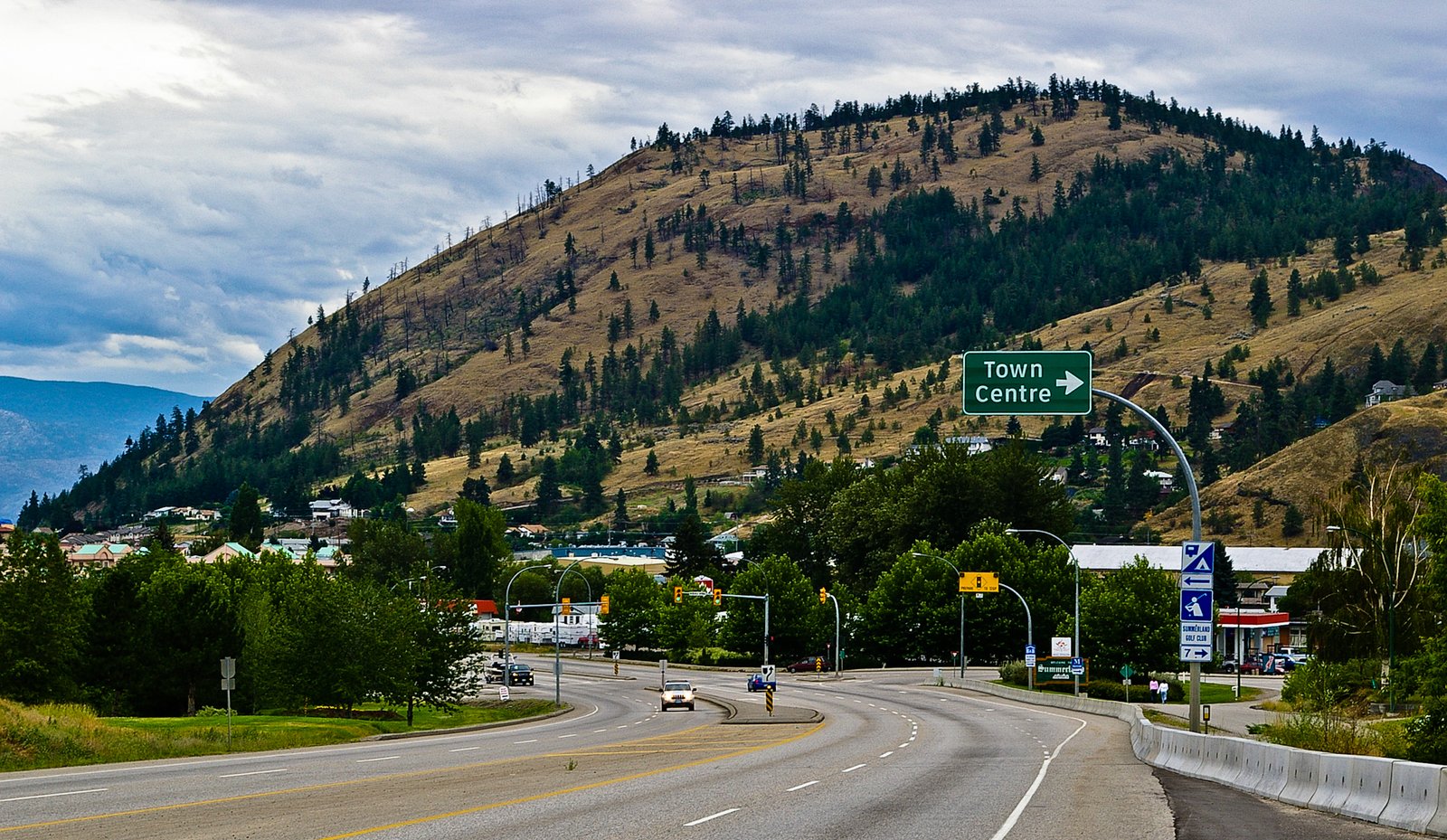
Thumbnail photo: “Highway 97 in Summerland, British Columbia” by Kurt Bauschardt, via Wikimedia Commons, licensed under CC BY-SA 2.0.

Related Reading
- Zero-Stop, Direct-Drive: Why Procurement Managers in Calgary and Edmonton Are Switching to Hotshot for Small Freight
- What Actually Drives Hotshot Freight Pricing in the BC Interior (And Why the Cheapest Quote Isn’t the Safest One)
- A Missing Component Stalls a Construction Site in the Okanagan: Anatomy of a 4-Hour Hotshot Save